What is going on?

Vice-President, Academic and Provost Sandra Gabriele has presented three proposals for restructuring OCAD University. Each would significantly change how the university is organized, how academic decisions are made, and how faculty and staff carry out their work.
All three proposals include the centralization of academic administrative support into a shared “back office,” replacing the current model in which administrative staff work directly within faculties. Yet there has been no completed assessment of staffing needs, academic responsibilities, or how these changes would affect teaching, curriculum delivery, faculty workload, and student support.
The administration has presented restructuring as a response to the university’s financial challenges and the need for greater efficiency. However, it has not provided financial projections showing how much, if anything, each proposal would save.
These are consequential changes to the academic structure of OCAD U. Faculty, staff, and students need clear information about their rationale, costs, and implications before they can meaningfully evaluate them.
What is the timeline?
On November 3, 2026, OCAD University’s senior administration circulated three proposed models for academic restructuring and invited faculty feedback. Ten consultation sessions are scheduled between November 9 and December 9. All faculty are welcome to participate and can register through the link provided in the VPAP’s email. Written submissions are also welcome.
The proposed timeline raises serious concerns. The Provost intends to seek Senate approval for a new academic structure in February 2027, with implementation planned for fall 2027.
Critically, the detailed assessment of staffing needs, academic responsibilities, workloads, and reporting relationships is not scheduled to take place until after Senate approval. This means faculty are being asked to evaluate major structural changes without a clear understanding of their implications for teaching, academic programs, working conditions, or student support.
The sequence is backwards. A thorough assessment of the impacts should inform decisions about restructuring, not follow them.
UPDATE (18 November): In response to community voices the admin has revised their timeline. The new timeline below is directly quoted from their “Share Back Notes”:
- November to December 2026: Continue consultation sessions, clarify the prototypes and provide additional information.
- January 2027: Plan the next phase of engagement and broaden participation to include other relevant academic and administrative units.
- February to March 2027: Hold collaborative, charrette-style design sessions to examine and redesign the structure options (prototypes).
- April 2027: Senate will be engaged in a process of deliberation and narrowing down the options and may require a special meeting if sufficient space is not available in the agenda.
- May 2027: A decision on the future academic structure.
- 2027/2028 academic year:
- “Implementation” was meant to signal a period where any governance changes would be decided upon; roles, workload and workflows would likewise be clarified. We anticipate this process will take approximately 18 months. But this was not sufficiently clear to all members of the community.
- Clarification – our “build phase” (previously called Implementation) will take place over the 2027-28 academic year. This gives us time to adjust governance where required; to address any processes that are not sufficiently clarified or re-designed by structure alone, including with units like the Registrar’s office, studio management, etc.
- 2028/2029 academic year: Launch of the new structure.
Will this mean job cuts?
The administration has not provided clear information about whether the proposed restructuring will result in job cuts. However, given that the proposals are being advanced in the context of financial pressures and a university-wide efficiency review, there are legitimate concerns about their implications for job security.
The proposed consolidation of faculties and the School of Graduate Studies, alongside the creation of a centralized administrative “back office,” could result in the elimination of support staff positions represented by OPSEU Local 576. With more than half of OCAD U’s faculty already employed in non-permanent positions, there are also concerns that restructuring could lead to fewer course sections and further job losses for OCADFA’s sessional faculty members.
OCADFA believes that Senate should not be asked to approve a new academic structure without a clear assessment of its implications for staffing, faculty workload, academic decision-making, and the quality of education. Nor has the administration provided a financial analysis demonstrating the projected costs or savings associated with each proposal.
Responsible decision-making requires that the consequences of restructuring be examined and understood before decisions are made, not afterward.
Has this happened at other universities?
OCAD U is not alone in pursuing academic restructuring in response to financial pressures. Similar initiatives at universities across Canada have raised concerns about transparency, collegial governance, job security, and the impact of restructuring on academic programs and working conditions.
The experiences of other universities offer important lessons for OCAD U.
1. Acadia University
In March 2026, Acadia University initiated an academic restructuring process that initially proposed extensive changes to its academic organization. The final plan, approved in June 2026, reduces the number of faculties from three to two, with implementation scheduled for July 2027.
The Acadia University Faculty Association (AUFA) raised concerns about the limited involvement of faculty and Senate in developing the proposals, as well as the lack of financial evidence supporting the restructuring.
Acadia’s experience raises important questions about how restructuring proposals are developed, whether faculty have a meaningful role in shaping them, and whether financial and academic consequences are adequately assessed before decisions are made.
2. University of Alberta
The University of Alberta underwent extensive academic and administrative restructuring following significant provincial funding cuts. In her article, “Uncollegial governance and the restructuring of the University of Alberta,” Carolyn Sale examines several concerns that are relevant to OCAD U:
- Financial urgency: Budget pressures were used to justify accelerated restructuring, limiting opportunities for thorough evaluation and deliberation.
- Collegial governance: Consultation processes provided opportunities for feedback but raised questions about how much influence faculty had over decisions.
- Transparency: Concerns were raised about access to external consultants’ reports and the evidence informing restructuring decisions.
- Academic integrity and working conditions: Restructuring raised concerns about disciplinary autonomy, faculty workload, and the consequences of centralizing administrative support.
There are important differences. Alberta’s restructuring was much larger in scale and unfolded over several years. OCAD U’s proposed restructuring is moving on a considerably shorter timeline, while both OCADFA and OPSEU Local 576 are engaged in collective bargaining.
3. Research on university support staff working conditions
A recent report, “Pushed to the Limit: A Study On The Psychosocial Hazards And Working Conditions Of University Support Staff“ by Dr. Adam Zendel, commissioned by OSSTF/FEESO, examines the working conditions and psychosocial hazards experienced by university support staff.
The report provides important context for understanding how organizational decisions affect workloads, workplace stress, and employee well-being. Its findings are particularly relevant to our colleagues in OPSEU Local 576, whose positions and responsibilities may be affected by the proposed centralization of administrative services.
They are also relevant to faculty. Changes to administrative staffing can redistribute responsibilities, increase workloads, and reduce the support available for teaching and students.
Restructuring is not simply an administrative exercise. Decisions about how a university is organized affect the people who teach, study, and work within it.
The experiences of other institutions underscore the importance of transparent financial information, meaningful faculty and staff participation, and a thorough assessment of the consequences before structural changes are approved.
How will this impact students?
The administration has not yet provided a clear assessment of how the proposed restructuring would affect students, their academic programs, or the services they rely on. Nor has it demonstrated how the changes would improve the quality of education at OCAD U.
Changes to the university’s academic and administrative structure are not simply internal management decisions. They can have a direct impact on students’ everyday experiences.
The proposed centralization of administrative support could mean fewer staff who are familiar with individual programs and their requirements, longer wait times for assistance, and less direct access to the people who help students navigate their education. Faculty consolidations could also affect how programs are managed, how curriculum decisions are made, and how effectively students’ academic needs are addressed.
If restructuring results in staff reductions or increased faculty workloads, students could experience fewer course offerings, larger classes, delays in academic advising, and reduced access to support. These are potential consequences that need to be assessed, not assumed.
What have students experienced at other universities?
University of Alberta
The University of Alberta undertook extensive administrative restructuring that eliminated more than a thousand positions and shifted many services from individual departments into centralized administrative units.
The changes raised concerns about the accessibility and continuity of student services, including academic advising and department-level administrative support. They also prompted questions about the extent to which students and faculty had a meaningful voice in decisions affecting their education.
Acadia University
At Acadia University, staffing reductions have affected student support services, including the elimination of positions at the Wong International Centre, which provided dedicated assistance to international students.
These reductions illustrate how university budget decisions can have consequences beyond the positions eliminated, affecting students who depend on specialized services and staff with knowledge of their particular needs.
What does this mean for OCAD U students?
Students deserve to know how the proposed restructuring will affect their education before decisions are made.
OCADFA believes the administration must provide a clear assessment of the implications for course availability, academic advising, program administration, student services, and the quality of teaching and learning.
The central question should be whether these changes will improve students’ educational experience—not simply whether they will reduce administrative costs.
What happened to OCAD U’s commitments to decolonization and equity?
Indigenous faculty have raised serious concerns with OCADFA about the proposed restructuring and its implications for Indigenous self-determination and academic autonomy. In particular, they have expressed concern that the changes could undermine the Indigenous Visual Culture (INVC) program, which has been carefully developed over many years through sustained efforts to decolonize the university’s curriculum, governance, and institutional practices.
Several Indigenous faculty members have met with OCADFA representatives to discuss these concerns and are preparing a public statement, which they also intend to present at an upcoming Senate meeting.
Their concerns raise a fundamental question: How can OCAD U uphold its commitments to decolonization and equity if decisions about academic restructuring are made without meaningful participation from the communities whose programs, governance, and autonomy may be directly affected?
Are the restructuring proposals a violation our Memorandum of Agreement (MoA)?
The administration has provided little information beyond organizational charts, making it difficult to fully assess the implications of the three proposed models for OCADFA’s Memorandum of Agreement (MoA). However, the scale of the proposed changes raises serious concerns about potential conflicts with existing provisions of our agreement.
Of particular concern is the proposal to replace Program Chairs with Department Chairs who would be positioned outside OCADFA’s bargaining unit. Such a change could have significant implications for bargaining unit representation, the roles and responsibilities of faculty, and provisions of the MoA governing academic leadership, committee structures, and faculty participation in decision-making.
The administration cannot simply reorganize academic structures in ways that disregard its negotiated obligations under the MoA. OCADFA will carefully examine the proposals to ensure that members’ contractual rights, working conditions, and role in collegial governance are protected.
Does OCAD U’s financial situation justify restructuring?
The administration has presented academic restructuring as a necessary response to financial pressures. Yet it has provided no financial analysis demonstrating what the proposed changes would cost, how much they would save, or whether they would produce meaningful long-term efficiencies.
For years, OCAD U has cited financial constraints to justify difficult decisions, including reductions in staffing, increased workloads, and compensation that remains below sector norms. Faculty and staff have repeatedly been asked to do more with less.
However, the university’s audited financial statements tell a different story from its budget projections. Since 2020, OCAD U has forecast cumulative deficits of $10.765 million while reporting cumulative annual surpluses totalling $38.115 million.
This substantial discrepancy raises serious questions about the financial assumptions being used to justify restructuring.
Financial challenges must be assessed transparently and based on evidence. Before proposing fundamental changes to the university’s academic structure, the administration should demonstrate why restructuring is necessary, what alternatives have been considered, and how the proposed changes will strengthen OCAD U’s educational mission.
For a more detailed examination of OCAD U’s finances, read OCADFA’s analysis and reporting on the university’s financial position: www.tinyurl.com/OCADfinance
What is OCADFA proposing?
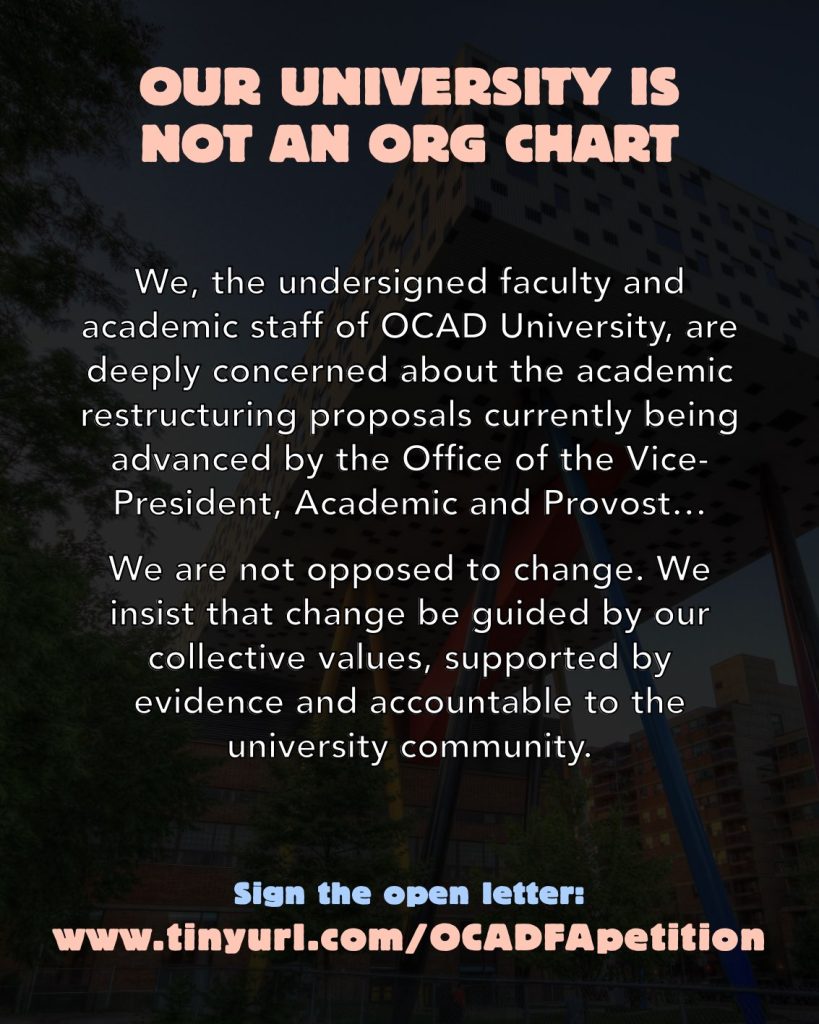
OCADFA has launched an open letter and petition calling for a transparent, accountable, and inclusive approach to academic restructuring.
The letter outlines Ten Principles to Guide Restructuring, grounded in OCAD U’s commitments to decolonization, collegial governance, academic integrity, and the future of public art and design education.
We encourage all members of the OCAD U community—faculty, staff, students, and supporters—to read the principles and add their names to the letter.