
What’s at Stake
The administration is asking Senate to approve a new academic structure before it has demonstrated why the changes are necessary, what they will cost, or how they will affect teaching, learning, and working conditions. OCADFA believes this process must be reconsidered.
1. No financial justification has been provided.
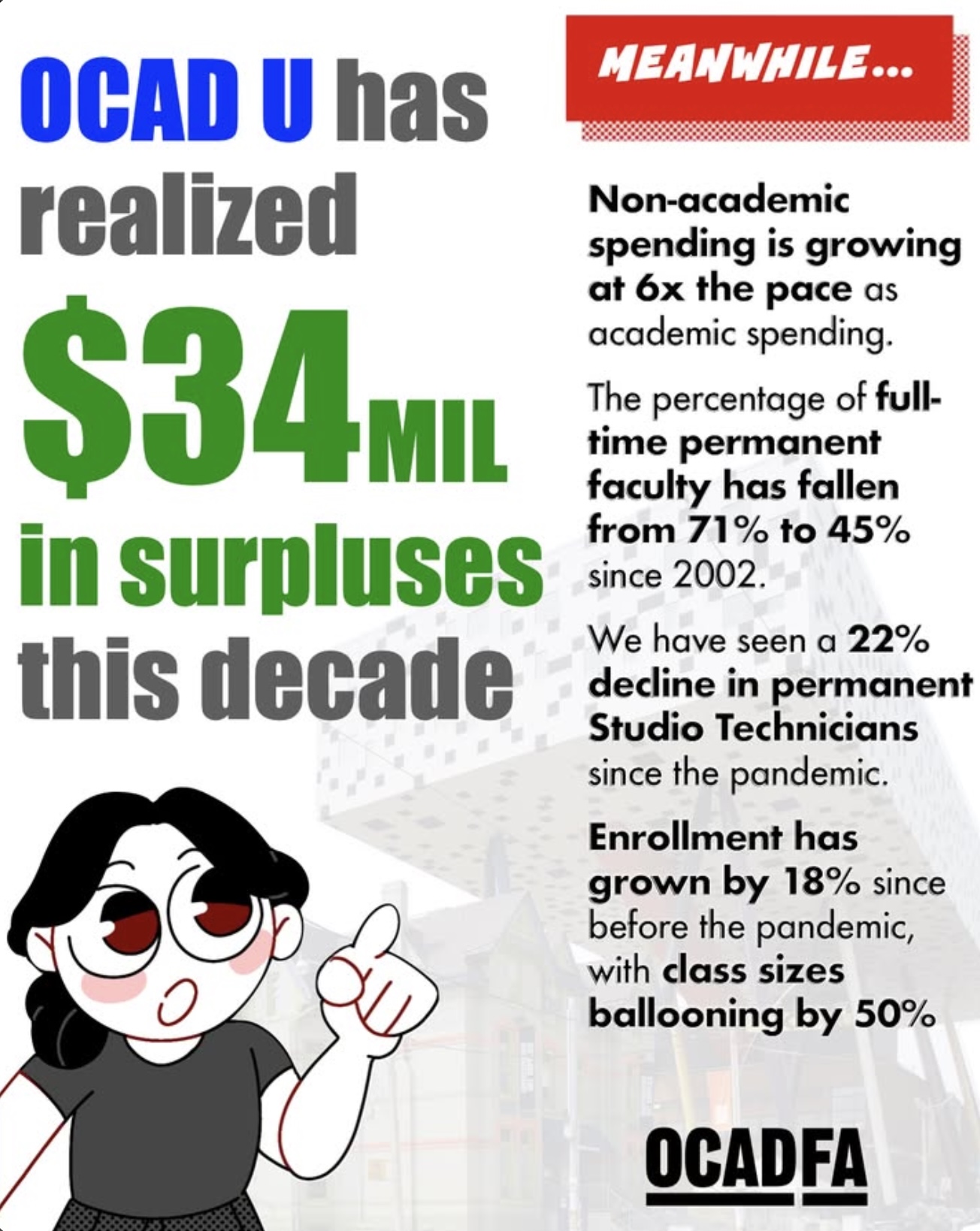
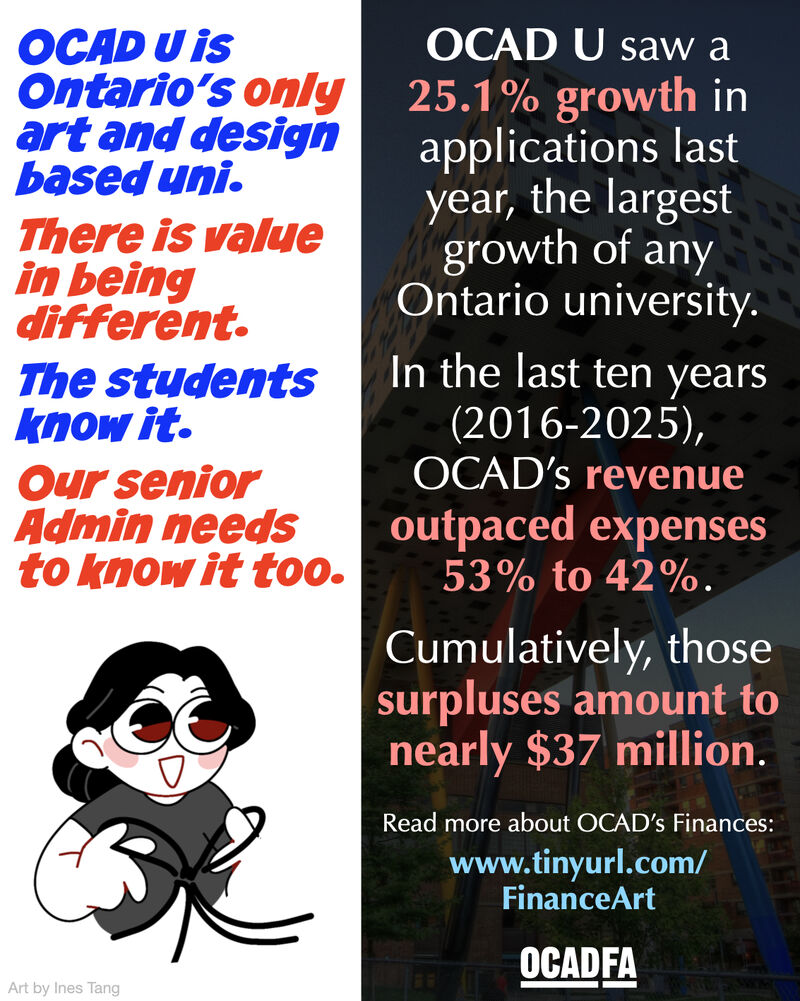
The administration has presented restructuring as necessary for OCAD U’s financial stability, yet has provided no analysis demonstrating the projected costs or savings of any of the three proposals. Major changes to the university’s academic structure must be supported by evidence, not assertions of financial necessity.
2. The timeline puts approval before assessment.
The Provost intends to seek Senate approval in February 2027, before completing a detailed assessment of staffing, workloads, academic responsibilities, and reporting relationships. The consequences of restructuring must be understood before decisions are made, not afterward.
3. Jobs, working conditions, and educational quality are on the line.
The proposals could fundamentally change faculty and staff roles, academic decision-making, and the support available to students. Yet the administration has not adequately assessed these implications or explained how the proposed structures would improve teaching and learning.
4. Consultation is not collegial governance.
Inviting feedback on proposals developed by senior administration is not the same as sharing decision-making authority with the academic community. Faculty must have a meaningful role in shaping the university’s future, not simply responding to decisions already framed by management.
5. OCAD U is a university, not a corporation.
Academic restructuring must be guided by the university’s educational mission, its commitments to decolonization and equity, and the principles of collegial governance—not simply by administrative efficiency. Decisions about academic programs must be shaped by the people who teach, study, and work within them.
How Will This Affect Students?
Restructuring is not simply a matter of changing organizational charts. It could fundamentally change students’ everyday experiences at OCAD U.
The administration has not provided a clear assessment of how the proposed changes will affect academic programs, course offerings, student services, or the quality of education.
Here’s what could be at stake:
- Less direct support for students. Centralizing administrative services could mean losing the faculty-based staff who know individual programs, understand their requirements, and help students navigate their education.
- Fewer courses and less choice. Changes to staffing and academic structures could affect course availability, class sizes, and students’ ability to complete their programs on time.
- Less support for teaching and learning. If administrative responsibilities are transferred to faculty, instructors could have less time for teaching, mentoring, and supporting students.
- Loss of specialized knowledge. Art and design education depends on close relationships among students, faculty, technicians, and administrative staff. Centralization could weaken the specialized support that makes studio-based learning possible.
- Less student influence over academic decisions. Consolidating faculties could place decisions about curriculum, programs, and academic priorities further away from the students and faculty most directly affected.
These are not inevitable outcomes, but they are serious risks that must be evaluated before restructuring is approved.
Students deserve to know how these changes will affect their education and to have a meaningful voice in decisions about the university’s future.
What Can We Do?
The future of OCAD U should be shaped by the people who teach, study, and work here. Faculty, staff, and students have an important role to play in ensuring that any changes to our university are transparent, accountable, and guided by its educational mission.
1. Sign and share OCADFA’s open letter.
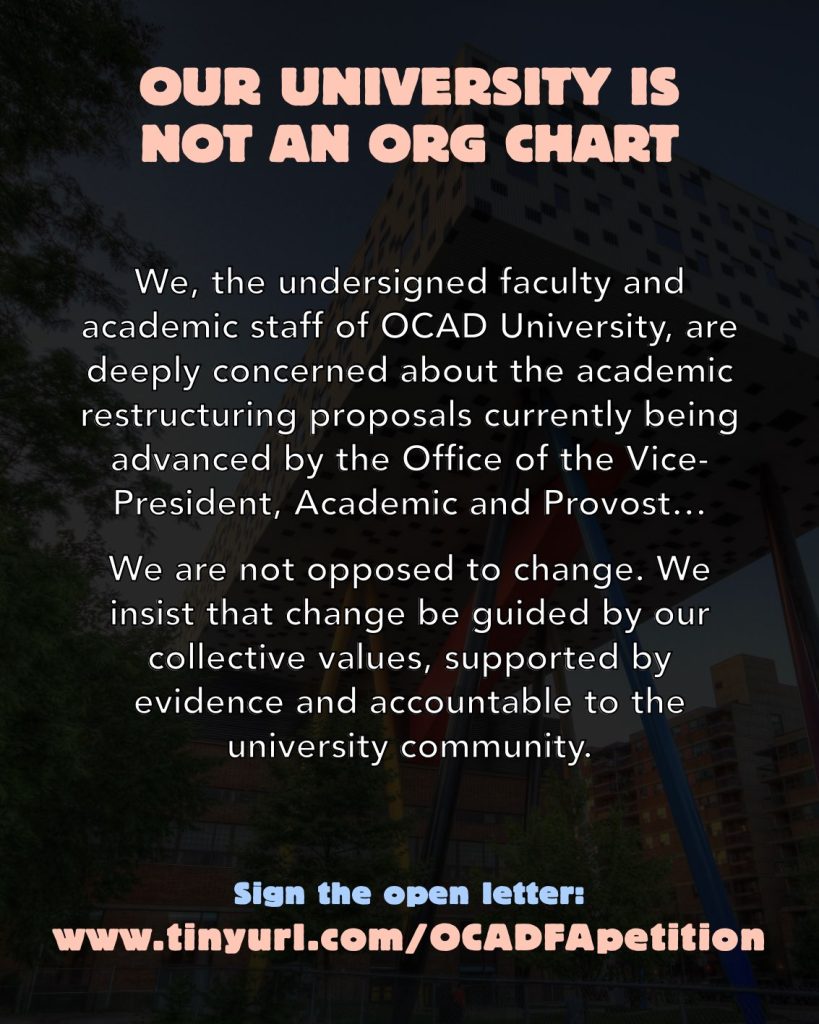
Our open letter outlines Ten Principles to Guide Restructuring, calling for meaningful collegial governance, transparency, protection of jobs and academic programs, and respect for OCAD U’s commitments to decolonization and equity.
2. Participate in the consultation process.
Attend a consultation session and ask the administration to explain the financial rationale, academic implications, and anticipated staffing changes associated with each proposal. Faculty can register through the link in the VPAP’s November 3 email. Written feedback can also be submitted.
3. Speak with your colleagues and students.
Share information about the proposals and discuss how restructuring could affect your program, teaching, working conditions, and access to student services. Encourage others to participate and make their concerns heard.
4. Contact your Senate representatives.
Senate is expected to consider the proposed restructuring in February 2027. Let your representatives know that decisions about academic restructuring must be informed by a thorough assessment of their educational, financial, and employment consequences.
5. Stay informed and get involved with OCADFA.
OCADFA will continue to examine the proposals, advocate for transparency, and work with faculty, staff, and students to defend collegial governance and the quality of public art and design education.
Please contact us with your thoughts and for information on how to get involved:
Our message is simple: Assess the impacts. Share the evidence. Respect collegial governance. Make informed decisions before restructuring our university.
3 November 2026
Dear colleagues,

Senior administration at OCAD University has circulated three proposed models for academic restructuring and invited faculty feedback. These proposals raise fundamental questions about the future of academic governance, our working conditions, and the kind of university we want OCAD U to be.
OCADFA recognizes that the University faces financial and organizational challenges. However, we must ask a central question: Is OCAD U seeking to create a more effective academic organization, or a less expensive and more administratively centralized one?
These are not necessarily the same thing.
The University’s strategic considerations repeatedly emphasize efficiency, resource optimization, institutional reputation and financial sustainability. These are legitimate concerns, but they cannot be the primary measures of a successful academic institution. By comparison, the evaluative conditions give relatively little explicit attention to faculty autonomy, academic freedom, employment security and democratic governance.
Academic leadership is not the same as managerial control. Effective academic leadership emerges from disciplinary expertise, collegial relationships, shared responsibility and meaningful faculty participation in decisions affecting teaching, research and curriculum. A structure that concentrates decision-making authority in fewer administrative positions may simplify reporting relationships without improving academic quality or accountability.
We are particularly concerned about the following:
- Collegial governance: Will faculty have meaningful authority over academic decisions, or will restructuring concentrate power in administrative leadership? The University’s stated intention not to create new formal decision rights requires closer examination of who will actually exercise existing authority.
- Workload: Will the proposed structures genuinely improve academic support, or will they transfer additional administrative, coordination and service responsibilities onto faculty and academic staff who are already stretched thin?
- Bargaining-unit protections: Prototype B proposes new Department Chair positions that may be classified as management and fall outside the MOA. What responsibilities would these positions assume, and what are the implications for bargaining-unit work and collegial governance?
- Academic integrity: How will the proposed models preserve disciplinary expertise, program identities, studio-based education and the diversity of our pedagogical approaches? Academic programs are communities of knowledge and practice, not simply administrative units to be consolidated.
- Equity: How will restructuring affect different appointment categories, disciplines and programs? Changes presented as administrative efficiencies can have unequal consequences for faculty and academic staff, particularly when existing workloads and resources are already uneven.
- Financial transparency: What evidence demonstrates that these changes will produce meaningful savings or improve educational outcomes? What are the projected costs, staffing implications and academic consequences of each model?
These questions are especially consequential because OCADFA is currently engaged in collective bargaining. The University cannot treat academic restructuring as separate from the negotiated rights, responsibilities and working conditions of faculty and academic staff.
OCADFA is reviewing the proposals against our existing Memorandum of Agreement and seeking guidance from the Canadian Association of University Teachers (CAUT). We will insist that any restructuring respect our collective agreement and the principles of collegial governance.
We encourage all members to examine the proposals critically and participate in the consultation process. We also ask you to share your concerns with OCADFA, particularly regarding the implications for your programs, workload, academic responsibilities and students.
OCADFA’s participation in consultation does not constitute endorsement of any model or agreement to changes affecting members’ rights and working conditions.
The University’s financial challenges are real, but they cannot be resolved by weakening collegial governance, diminishing academic autonomy or transferring more work onto fewer people.
Our working conditions are our students’ learning conditions.
In solidarity,
Min Sook Lee
President, OCADU Faculty Association