The OCAD University Faculty Association (OCADFA) represents all faculty and academic staff at OCAD, with over 600 members. Our collective agreement (referred to as a Memorandum of Agreement, or MoA), expired on June 30, 2025. We are currently attempting to negotiate a new agreement that would Raise the Bar! for our members, and our students.
This page is your one-stop shop for all information concerning OCADFA’s efforts to negotiate a new MoA with the OCAD University Administration.
Our current agreement expires at the end of the current academic year, but the provisions of the 2023-2026 MoA will remain in force until a new agreement is reached, or is awarded by an Arbitrator.
Please see below for backgrounders on what we’re bargaining for (our Bargaining Mandate), and all other information you need to state up-to-date with the ongoing negotiations, and how your can support your Negotiations Committee.
For regular bargaining updates: www.ocadfa.ca/bargaining-updates
CONTEXT
The corporatization of Canadian universities and chronic underfunding of public services, including post-secondary education, has led to a state of crisis in the sector. Administrations keep asking faculty and academic staff to more with less, and in response we’ve seen an unprecedented number of strikes at universities and colleges across the country in recent years. We’re in a similar state of crisis at OCAD.
More funding is needed, but OCAD can also do better with what we have.
OCAD’s Administration repeatedly resorts to fear-mongering about their projected budgetary deficits, meanwhile the University has realized surpluses amounting to $34,135,603 this decade. Even if we take out capital gained from the sale of real estate, OCAD has still accrued over $20 million in surpluses over this time, and has put away $11.5 million into a “financial sustainability fund.”
Budgets reflect priorities. Since 2020, OCAD’s Administration has consistently prioritized non-academic pending over academic spending, with non-academic spending growing at six times the pace as academic spending.
As a result, OCAD lags well behind other universities in terms of working conditions, benefits, and pay. And falling further behind. The percentage of full-time permanent faculty at OCAD has fallen from 71% to 45% since OCAD became a university roughly 25 years ago. We have also seen a 22% decline in the number of permanent Studio Technicians since the pandemic. These declines in stable staffing comes as enrollment has grown by 18% since before the pandemic, with class sizes ballooning by 50% in that time.
Faculty and academic staff are being asked to do more, with less. We all deserve better!
THE BARGAINING PROCESS
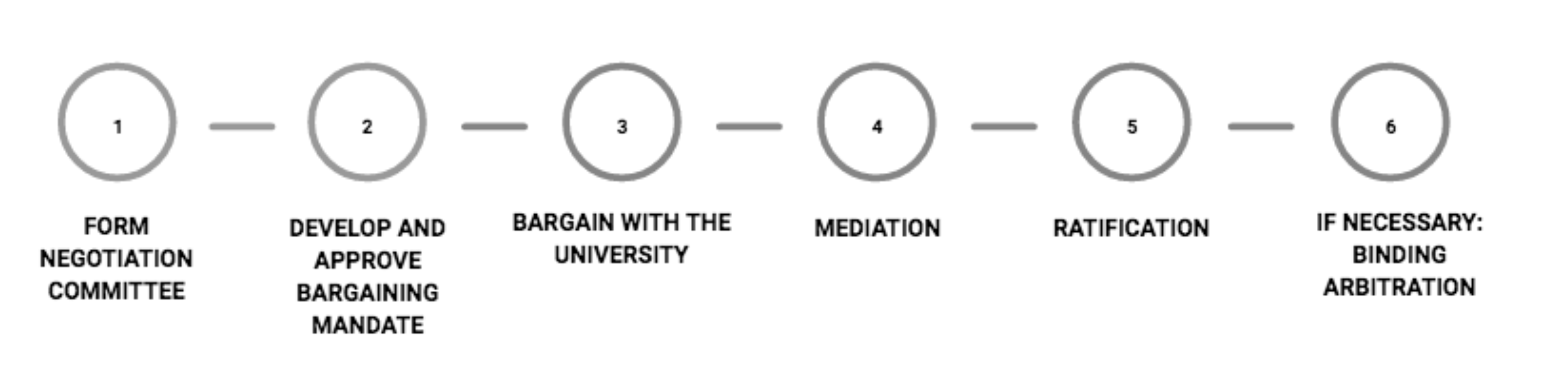
We are currently in stage 3 of our bargaining process. Please check our Bargaining Bulletins page for updates, as well as our social medial platforms where announcements and updates will be posted throughout the bargaining process.
BARGAINING MANDATE
Our bargaining mandate was established through extensive consultations with the OCADFA membership throughout 2025. Members provided input through regular membership meetings, targeted labour category consults and surveys, and a membership wide survey in the spring of 2025.
Your Negotiations Committee coalesced all this feedback into a Bargaining Mandate which was approved unanimously at our Fall Membership Meeting in October 2025.
SEVEN PILLARS
(click to jump)
A) Fair and Reasonable Compensation
B) Job Security and Full Recognition of Contributions
C) Efficiencies
D) Sustainable Workloads
E) Supporting Health and Wellness
F) Indigenization
G) LOUs, Housekeeping, and Labour Relations
A) Fair and Reasonable Compensation
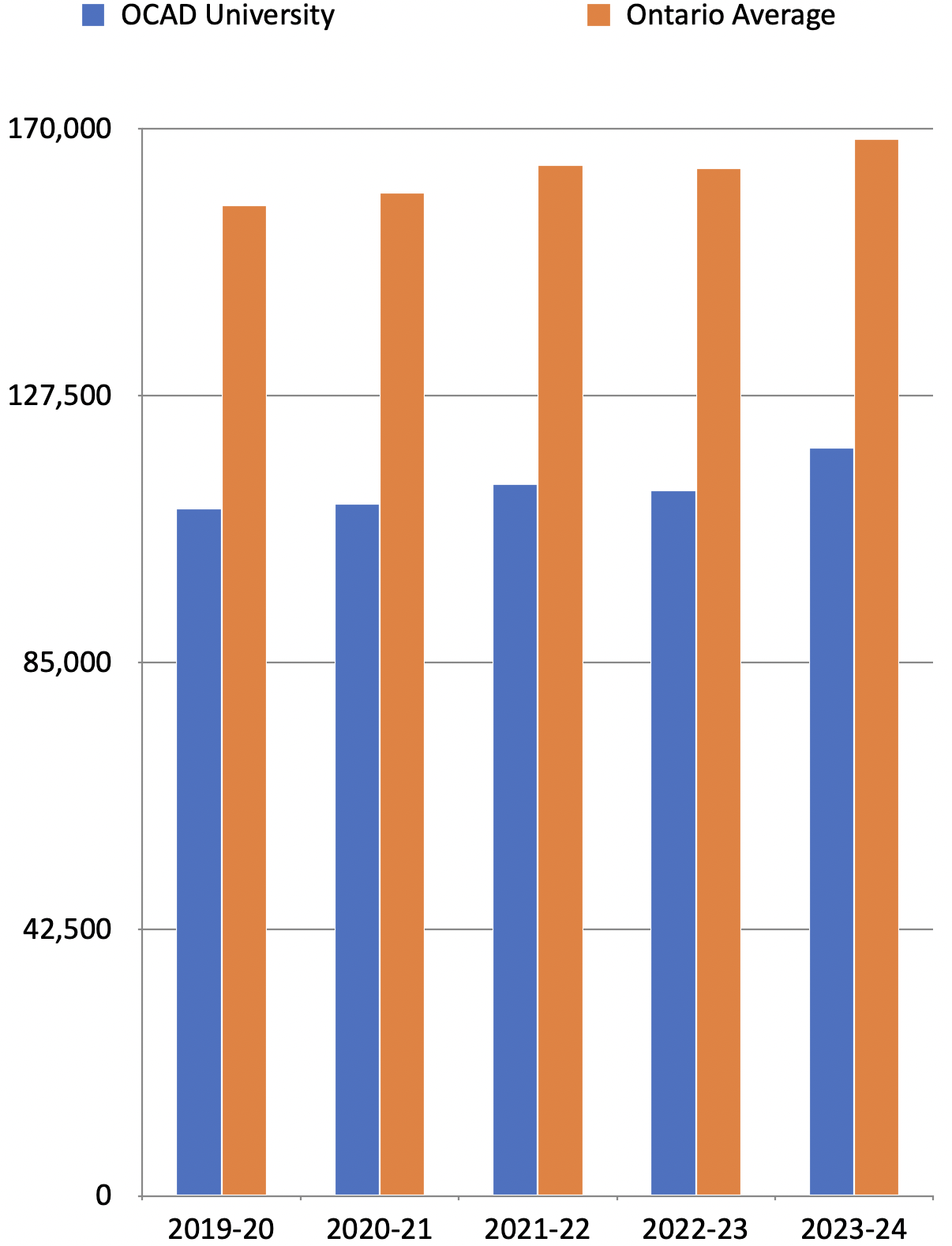
Source: Statistics Canada
Compensation for OCADFA members lags well behind the sector norm.
- In 2023-24, the average OCAD full-time faculty member made $49,179 less than the provincial average, and our annual “Progression Through the Ranks” (PTR) raise is the smallest in Ontario, meaning our members are falling further behind every year
- OCAD’s TAs make more than $10 an hour less than TAs at other universities
- The base Sessional contract at OCAD is $7,508, the lowest in the GTA—compared to $10,670.50 (York), $9,820.70 (U of T), and $7,770.15 (TMU)
OCADFA is proposing to Raise the Bar! through:
- A reasonable across-the-board increase for all labour categories
- Safeguarding the ability of faculty and academic staff to retire with dignity by moving to a defined benefit pension plan
- Ending the pay disparity between tenured and other non-sessional faculty, and permanent and contract academic staff, by placing everyone on the same salary scales
- Eliminating the lowest steps to raise the salary floor, and introducing new steps to raise the salary ceiling
- A market adjustment on-top of any across-the-board increases to bring our TAs closer to sector norms
- A premium for faculty assigned to large-format classes
B) Job Security and Full Recognition of Contributions
The need for improved job security was once again identified as a top priority for OCADFA members going into this round of bargaining. We believe job security is imperative not only for the employment stability of individual members, but for the betterment of the University as a whole. Faculty and academic staff who feel secure in their employment also feel secure to innovate, secure to fully participate in the University community, secure to commit to long-term projects, initiatives, and professional development, and feel secure to exercise their academic freedom. Job security is about more than stable employment, it’s about the security to perform our jobs at the best of our abilities.
More than half the faculty are OCAD are precariously employed with no pathway to permanency. It doesn’t have to be this way. Prior to obtaining university status, part-time faculty at OCAD were considered permanent after five years of continuous teaching. This meant 71% of OCAD’s faculty had permanent employment. Sessional faculty were no longer recognized as permanent once OCAD obtained university status in 2002, and the number of permanent faculty has since plummeted. OCAD the college had more faculty stability than OCAD the university – this is unacceptable.
We have also seen increased reliance on contract Studio Technicians, who are capped at three years of employment, with a 22% decline in the number of permanent Studio Technicians since the pandemic. This too needs to be rectified.
At $1,400 for Tenured faculty and $750 for Teaching Stream and permanent Academic Staff, the Professional Development funding available for OCADFA members is less than half the norm, despite the absence of a separate fund to reimburse the costs associated with attending conferences.
OCADFA is proposing to Raise the Bar! through:
- Stable employment for Sessional faculty who are consistently employed by the University
- Limiting the use of contract positions to provide for improved job stability for studio Technicians
- A title change for Technicians that more accurately reflects their contributions to the University
- Access to sabbaticals for all permanent faculty and academic staff
- An increase to Professional Development funding to better align the University with sector standards.
C) Efficiencies
OCADFA members are forced to undergo unnecessarily cumbersome application and review process not only to get their job, but then to keep them, and to rise through the ranks. Teaching Stream members are interviewed and asked to give a public job talk to achieve permanency, even if they’re up for their third contract and have been working in their current role for 6-10 years. Sessional members have to submit a massive application package to ask for the right to be reappointed to a course they have already taught at least four times, and only if that course is available for Sessionals. Despite an agreement to prioritize graduate students for TA positions, the process of securing a TAship remains extremely opaque.
Its time to significantly reduce ‘make work’ application and review processes.
OCADFA is proposing to Raise the Bar! through:
- Streamlining the Sessional and TA appointments processes
- Reducing the need for cumbersome application and review processes
D) Sustainable Workloads
Our working conditions are student learning conditions. Here’s just two examples: in our 2024 Membership Survey, 76% of respondents said high instructor-to-student ratios were affecting the quality of course delivery, and 73% reported that it has affected their ability to provide support for students.
The average course size ballooned during the shift to online learning during the pandemic, and have never come down, moving from 20.49 students per section in 2019-2020 to 26.37 students per section in 2020-21, and then shooting up again to 29.46 students per section in 2021-22. These inflated class sizes have become normalized, but it comes at the cost of faculty and academic staff workloads, and to the detriment of the student learning experience.
Its been awhile since section sizes have been disclosed to OCADFA, but since the university has slashed the number of sections offered in the last two years by 20% (from 1,322 sections in 2023 to 1,053 in 2025), despite consistent or growing overall student enrolment, we can deduce the problem has only gotten worse.
Simply put, the workload demands placed on faculty and academic staff have become unsustainable, and it must be addressed.
OCADFA is proposing to Raise the Bar! through:
- Eliminating the Marker/Grader position while significantly increases the provision of in-class Teaching Assistants, including for studio courses
- A clarified and strengthened agreement to recognize graduate supervision
- A student accommodations task force to make recommendations that will mitigate impacts on workload while providing support for students
- A teaching release from one course for faculty members who bring in a substantial amount of external research funding and commitments
- Reduced service requirements for new faculty in their first year of employment at OCAD, to provide for a smoother transition
- A course release to allow faculty to complete their PhD
- A maximum of one new course per year for each faculty member
E) Supporting Health and Wellness
Did you know that less than half of OCAD’s faculty have access to health benefits? That’s unacceptable.
For those who are eligible to join the group benefits plan, we saw some modest increases in the last round of bargaining so our benefits now match the Administration’s, but we’re still well behind sector norms, and well behind what is needed. Take vision care, for example. The average coverage for faculty across the province is $530/2-year period while even with our improvements OCAD faculty get only $300. Mental health coverage goes as high as $10,000 per year at some universities, while our members are capped at $2,000. And for dental care, some universities provide unlimited basic procedure coverage, while only one university provides less than the $2,000 per year provided by OCAD. We’re also one of the few universities without any orthodontic coverage.
OCADFA is proposing to Raise the Bar! through:
- Establishing minimum meeting frequencies from the Employment and Educational Equity Committee
- Expand access to all OCADFA members, including the elimination of employee premiums
- Coverage improvements to fall inline with member needs and sector norms
F) Indigenization
Indigenous peoples are the most underrepresented group among faculty in Canada, compared to their proportion of the general population. OCADFA is committed to Indigenizing the University and engaging in conversations on how we can decolonize practices and improve our MoA to work better for Indigenous faculty and academic staff.
We’re reserving space to table proposals that come from the Indigenization Working Group provided by our current Letter of Understanding Re: Indigenization.
G) LOUs, Housekeeping, and Labour Relations
There are a number of Letters of Understanding appended to our MoA that need to be renewed (like the tuition rebate) and other “housekeeping” that needs to be done to correct typos and wording inconsistencies throughout the MoA. We also need to modernize the MoA by making it gender-neutral and recognizing the advent of new technologies that impact our work and risk erosion of our intellectual property protections, specifically the rise of generative artificial intelligence.
Also, most universities in Ontario recognize the service provided by elected officers of the unions who represent faculty by relieving their teaching responsibilities; this does not happen at OCAD. This also needs to be fixed.
OCADFA is proposing to Raise the Bar! through:
- Recognizing the rise of generative artificial intelligence while protecting intellectual property rights
- Making our MoA gender-neutral
- Renewing Letters of Understanding as needed, fixing typos and wording inconsistencies throughout the MoA
- As nearly every other administration in Ontario already does, we’re asking for the OCADU administration to recognize the service provided to the University by the elected officers of OCADFA
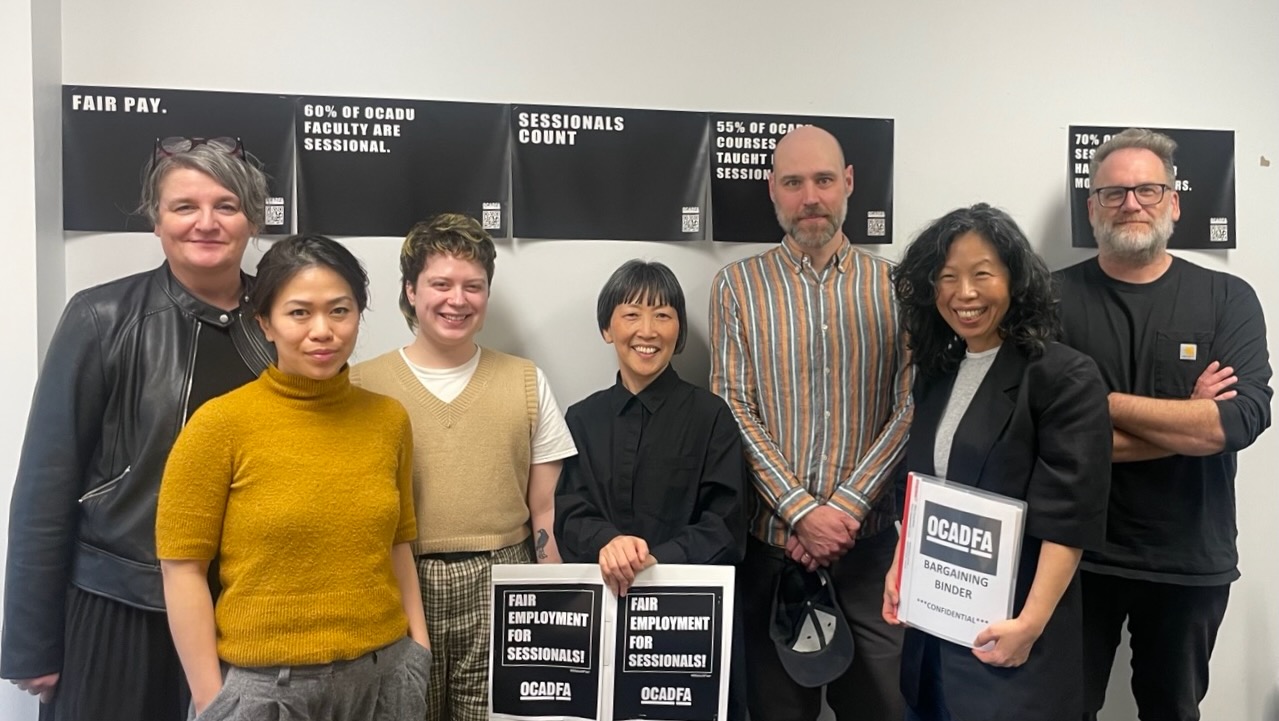
Negotiations Committee
- Noah Holub, Faculty of Arts & Science – Representative for Teaching Assistants and Research Assistants
- Annie Tung, Negotiations Chair, Faculty of Design
- Min Sook Lee, (OCADFA President, ex-officio), Faculty of Art
- Ross Bullen, Faculty Arts and Sciences – Representative for TS, CLTA and Continuing faculty
- Jana Macalik, Faculty of Design – Representative for Probationary and Tenured faculty
- Eric Steenbergen, Studio Services – Representative for Technicians
- June Pak, Faculty of Art – Representative for Sessional faculty